Find us on Google+ Inventor Tales

Wednesday, August 17, 2016

10 Years! Unbelievable!

I can't believe it !  On this very day, in 2006, I created my first blog post for InventorTales.

It was under a different name then, it was actually about 8 years ago, that InventorTales took form.

The very first image posted to my blog. 

An Autodesk Fusion 360 rendering I created last night.
This product wasn't even a dream when I created my first post. 


But still, I'm stunned.  Has it really been that long?

10 years ago, I was;

  • I was younger! 
  • I had hair!
  • I was in better shape! 
  • I was single!
  • Inventor was't using years to reflect versions
  • Fusion 360 wan't a glimmer on the horizon yet! 
It's been an amazing 10 years!  The one thing I've learned is that things are always changing!

Thanks for an amazing decade!  I hope to keep things up for another ten years, even as times change!


Tuesday, August 16, 2016

Lessons in Manufacturing from 75 Year Old Airplane.

Have you ever looked at a manufacturing process and thought, "When was that process developed?"

I had that moment looking at a set of ailerons for a Seversky AT-12 Guardsman at Planes of Fame Air Museum, where I volunteer on the weekends.

The Seversky AT-12 Guardsman at Planes of Fame
Stripped of the fabric that normally, covers them, I had a rare opportunity to see the structure beneath.

Typically Structures of the era would be made of wood, or riveted aluminum like the images below.

An example of  riveted aluminum. 

A typical aluminum control surface.
This is in the process of being recovered in fabric. 
Instead, these structures were made of welded stainless steel that had been spot welded together.

A close up of the stainless steel structure.  The spot welds are the dark spots on the ribs.
And speaking of the era, the ailerons still bore their manufacturer's data plates.  Built by Fleetwings, in 1940.


My curiosity piqued, I looked up the company on the internet.

I found that Fleetwings started in the mid 1920s, and pioneered the use of stainless steel in aircraft structures.

It seems that this set of ailerons represents a small milestone in manufacturing of aircraft structures. The use of stainless steel.

It's an interesting note in manufacturing history!  All prompted by looking at a set of old ailerons.


 With so many tools that we have, we can be better, faster, and more efficient.  But don't forget to use those tools to be come something else. 

Become more curious, and always keep learning! 

Monday, August 08, 2016

The Art of Development - Give Your Content a Chance to Mature!


Today is a "5 minute" post.  Just a little idea I had while working in Autodesk Inventor. 

In my current engagement, I've taken on creating custom content in Autodesk Inventor's Content Center.  That means creating tables, upon tables of various hardware.  Mostly NAS and NASM hardware.  

It's not difficult, but it takes time, and it takes patience.  And that means there are times that I have to leave content incomplete, not ready to use, but it's still in the shared content database, exposed to the users. 

So that left me with a conundrum.  How do I make sure the users don't accidentally use the content before it's ready to release?  

I thought of the traditional route, which is to put "Do not use" or something similar in the family description, but then I had an idea I liked a lot better. 

I decided to use an image.  Just how graphical images are used to convey important information quickly

You can see the image I used in the screen capture below. 

Can you guess which one you shouldn't use?  


So enjoy the bit of humor I used to break up a long, tedious day.  And perhaps think of how you can use that in your daily projects, for both practical purposes, and maybe a little bit of humor! 

Tuesday, August 02, 2016

Embedding Designs in Autodesk Fusion 360 - My Practical Case

Wrapping up an aircraft maintenance class is a bittersweet experience for me.

On one hand, I miss sitting in a hangar full of airplanes, doing homework, while chatting with my classmates about.... airplanes.

What gearhead wouldn't want a classroom like this? 
On the other hand.... I suddenly have my weeknights back to relax! 

So how did I spend one of my first evenings free?  I took a fundamental lesson I learned in class, and integrated it into Autodesk Fusion 360.  

What was the lesson?  

It starts with something my aircraft maintenance teachers, both my formal instructors and my colleagues with far more experience have continually reinforced. 

"Know your references to your information!  Book, chapter, page, and paragraph!"  Sometimes they would add, "And because your buddy said so does not count!"

That meant looking through a lot of books, real paper books.  If I was lucky, I had a PDF that I could scan through.  But even that took time.

Manuals in Aircraft Maintenance are big, heavy, and required! 


I quickly learned to write down key class info in a small composition book, naturally, I included the relevant book, chapter, page, and paragraph.

My little composition notebook.
But next came rivet spacing.  It's the standard spacing found in the FAA Advisory Circular AC43.13

The image from AC43.13. 


Sure, I can write it down in my composition, and naturally, I did!   But I also decided that I would build it in Fusion 360, just for a little practice.

The completed rivet pattern in Fusion 360


But as I finished up my little practice exercise,  My teachers words echoed in my mind.

How can I make the most use of this.  How can I make the information available.

Why?  It's available to anyone with the link, and it's a good visual representation of the finished product.  (Note that AC43,13 is referenced in the title block)


It's a link in the chain of information.  Just like I was taught, it's part of knowing where to find the information.

And it's not about knowing the information, it's about knowing where to find it!

So here's another example of embedded information in Fusion 360.  If you'd like to see the full steps, I wrote a post on that subject here.

Take a look!  And see if it can help you! .  

Sunday, July 24, 2016

5 More Things Aircraft Maintenance Taught Me.

I've been busy.  Crazy busy.  It's why I have been really bad about blogging.

The last five weeks, I've been taking an Aircraft Maintenance class.  This class is mostly book work, as a matter of fact, it's all book work!

It means many a night of being the first up in the morning, and the last to bed at night.

My days start at 4:30 AM.  They end at 11 PM at night.

But while it's time consuming, and at times frustrating, it's good to learn new things.

This includes everything from basic math, to FAA rules and documentation, to Calculations of Weight and Balance.
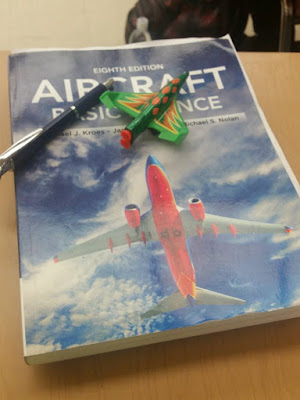
My text book.  I found the toy airplane laying on an airport tarmac.
Being a strange place to find a toy, I took as my "learning'" totem.
It reminds me to find joy in learning new things.

I could bore you with the details  of moments, engineering notation, Form 337, and AC43.13, but that wouldn't be much fun, would it?  Calculating the empty weight center of gravity of an aircraft isn't exactly the pinnacle of excitement!
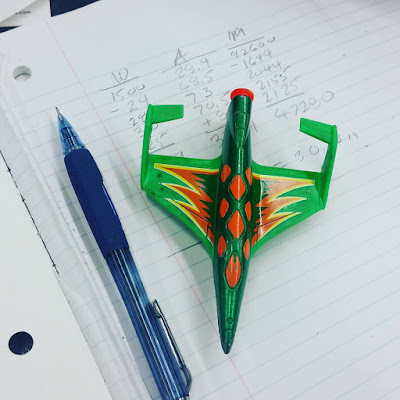
Empty weight CG calcs.  With my learning totem.
I'm sure you can hardly contain your excitement.

And I get more out of these classes than that.  These are lessons beyond the syllabus, things I've observed in those times I look up from my textbook and observe the environment around me.

So what things did I learn?

1) Look for the inspiration of others. 

I look around my classroom and see many a 20 something "kid".  And some of them struggle with the course material.

I suppose I could make some snarky comment about the failure of public education or "those lazy millennials".

But the truth is, I've seen many of these students curse under their breath, then put their nose back into the book and try again.  And again.  And again.

They refuse to give up.  And then they succeed.  They succeeded because they were just to stubborn to give up.

2)  Class May End, but the Learning Doesn't

Being in a constant observation mode has made me better at learning.  And learning everywhere. I go. Sometimes its a document I find doing research for work has applications at school, sometimes its realizing that knowing how to safety wire means I'm better aware what it takes to make a design work.

Sometimes it's knowing when to listen when an old mechanic has something to teach you.
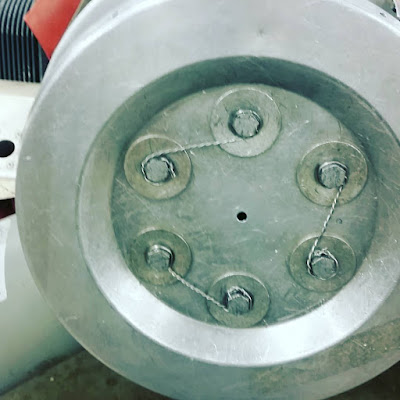
Safety Wire that I tightened.  Not bad, but it could be better.
Next time, it will be better. 


The lessons are many, and they breed other lessons.

3) An Ounce of Patience Can be Worth a Ton of Rework. 

One habit I continually struggle with is the desire to hurry.  Much of my career has been spent in the "hurry up corporate offense".  But many times the plan needs to look like
  • Read the manual
  • Form a plan
  • Reread the manual
  • Adjust the plan
  • Execute the plan
Why?  I've mad the mistake of hurrying.  Then had to redo something because I rushed the job.  The result?  The whole thing took a lot longer than just doing it right the first time. 

Obvious?  It should be, do I always follow that advise?  Not as often as I should.
\
But I follow it a lot more than I used to.

4) Experts Know What They Don't Know.

The best aircraft technicians, and best mentors I've had, have the repair manual close by.  Do they know their job?  Absolutely.  They're some of the best you'll find.  

But they also taught me, "When in doubt, you'd better check that manual!". Why?  They know that they can't memorize every last little detail.  But the manual has everything they need.  
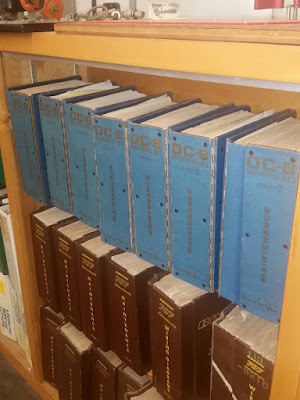
Maintenance Manuals.  The best friend you can have. 


When I first started taking these classes, I figured I would be working on my own, spending a lot of nights studying.  But something quite amazing happened. 

Help came.  It wasn't help I asked for, it was help that came to me. 

People found out I was taking these classes, and they helped me. They shared their knowledge.  Sometimes it was a few helpful tips.  Sometimes they handed me a drill and said "You're going to learn how to drill out a #30 rivet today".  

Sometimes, it was a few kind words of encouragement when the long days seemed to be too much to bear. 

I didn't go seeking these people.  I simply found myself in the right place at the right time.   And when they saw me trying to help myself, they helped me stand taller than I could on my own. 

All it came with was a silent request that I return the favor when someone else needed it.  And I promise them that I will. 

In Conclusion

Here are 5 more things I learned from my Aircraft Maintenance classes.  Do I expect you to take your own maintenance classes?  No.  Of course not. 

But I'd encourage you to find your own "5 things".

Never quit learning, never quit looking for inspiration, and look for it in whatever form it takes.